Oakland Free Library
Martin EdenThe Oakland Free Library is the setting in which Martin Eden first confronts the breadth of human knowledge as something he might actively pursue. Drawn there partly by the hope of encountering Ruth Morse, he finds a world that humbles and stimulates him in equal measure. The library’s shelves, reference department, lending system, and reading room subsequently give practical form to his self-education: a place to borrow books, test possible futures, absorb poetry, and study the writing that magazines publish.
First Visit and the Scale of Knowledge
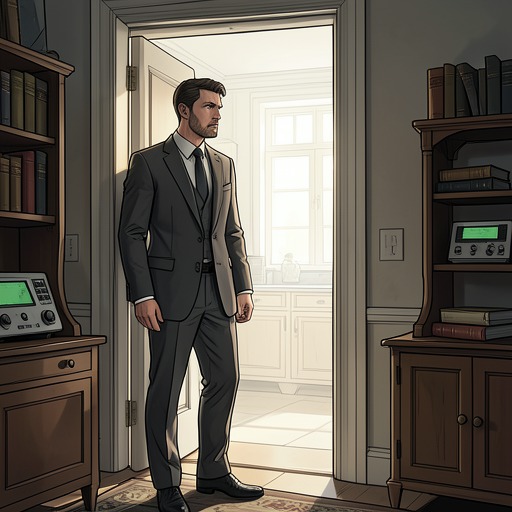
Martin chooses the Oakland Free Library over the Berkeley Free Library because Ruth lives in Oakland and he imagines he might meet her there. Unfamiliar with library procedure, he wanders through the fiction stacks until an attendant directs him upstairs to the reference department. He does not know enough to ask the man at the desk for guidance, so he starts in the philosophy alcove, where the tall shelves of heavy books make knowledge appear almost physically overwhelming. The collection is at once a rebuke to his limited preparation and an invitation to use the strength of his mind.
His encounter with mathematics makes the gap between his existing education and the library’s resources especially plain. He opens books on trigonometry but sees only formulas and figures that seem to belong to an alien language. The knowledge is familiar to Norman Morse and Arthur Morse, Ruth’s brothers, but not to him; he leaves the alcove in despair. The library thus makes class difference tangible through access to intellectual vocabulary: what one family takes for granted is, to Martin, a threshold he cannot yet cross.
That first discouragement gives way to a self-imposed challenge. Martin recognizes that other men have mastered the learning represented by the shelves, and resolves that his own brain can do the same. In a miscellaneous section, he finds Norrie’s Epitome, whose subject feels kin to his experience of the sea, and then encounters Bowditch alongside books by Lecky and Marshall. He briefly imagines teaching himself navigation, becoming a captain, and thereby making himself a suitable husband for Ruth. But his thoughts turn to the conflicting power of shipowners and underwriters, and to the fact that captains cannot take their wives to sea. With the library’s many books before him, he decides that his ambitions must be pursued on land rather than through a return to seafaring.
Etiquette, Access, and the Librarian
The library also becomes the place where Martin tries to solve a social problem that his reading has not prepared him to answer. He searches for books on etiquette because he wants to know how soon he may call on a young woman who has invited him. The shelves offer an immense system of visiting-card rules and polite conduct, but no answer to his immediate question. He leaves with the impression that mastering social manners could consume a person’s entire life, and that one would need a preliminary life simply to learn how to behave properly.
On a later occasion, the man at the desk asks whether Martin found what he wanted. Martin answers politely that the library is fine, but the unanswered question continues to trouble him. By then, the desk attendant has seen him often enough to greet him with a smile and a nod. That growing familiarity gives Martin the confidence to ask directly about the proper time to call on Ruth—whether in the afternoon, away from mealtimes, in the evening, or on Sunday. The librarian offers a solution more direct than the manuals Martin had searched: telephone her and find out. Martin agrees and leaves with his books. The exchange shifts the library from a silent storehouse of rules into a place where a personal question can be asked and answered through ordinary human contact.
A Working Base for Self-Education
Martin’s visits become regular and extend across the Oakland and Berkeley libraries. He fills out membership applications for himself, his sisters Gertrude and Marian, and Jim, persuading Jim to consent by buying him several glasses of beer. The resulting four cards allow books to be drawn for the household. At home, Martin reads by gaslight late into the night in the servant’s room, paying Mr. Higginbotham fifty cents a week for the gas. The library’s lending system therefore supports a routine that reaches beyond its walls, while the cost of sustaining that routine presses against Martin’s already limited money.
The books do not make his progress effortless. Each volume opens onto further fields of knowledge, and he repeatedly finds that he lacks the preparation expected of a reader. Poetry, however, offers both delight and an entry point. He reads more Swinburne than Ruth had lent him and discovers Kipling’s poems, whose rhythm and treatment of familiar life hold his attention. Later, when difficult books defeat him, poetry remains a source of beauty and pleasure. Works such as Gayley’s Classic Myths and Bulfinch’s Age of Fable illuminate references that had made other poetry difficult to understand. The library’s shelves allow his reading to move from frustration toward the background knowledge that makes more demanding work possible.
Reading Room and the Writer’s Apprenticeship
The library’s reading room broadens Martin’s education from books to contemporary literary practice. In the week after completing the first instalment of a sea-adventure serial, he spends each day writing three thousand words and each evening examining magazines and weeklies until the reading room closes at ten. He studies the stories, articles, and poems editors have chosen to publish, treating the periodicals not only as reading matter but as evidence of what the literary marketplace accepts. He tells himself that he can do what those writers do, and eventually surpass them.
A report he reads in Book News about magazine rates sharpens that ambition into a financial calculation. Learning that first-class magazines pay a minimum of two cents per word, he estimates that three thousand words could earn sixty dollars, and that the twenty-one-thousand-word serial he finishes on Friday might bring four hundred and twenty. He imagines buying clothes, magazines, and reference books, and even hiring a servant for Gertrude and buying a bicycle for Marian. Those imagined earnings prove optimistic, but the episode shows how the library connects literary aspiration to economic hope. It is at once refuge, classroom, and observatory: a place where Martin encounters the knowledge he lacks, studies the forms of polite society, and begins to measure writing against the published work and payment rates he finds in print.